

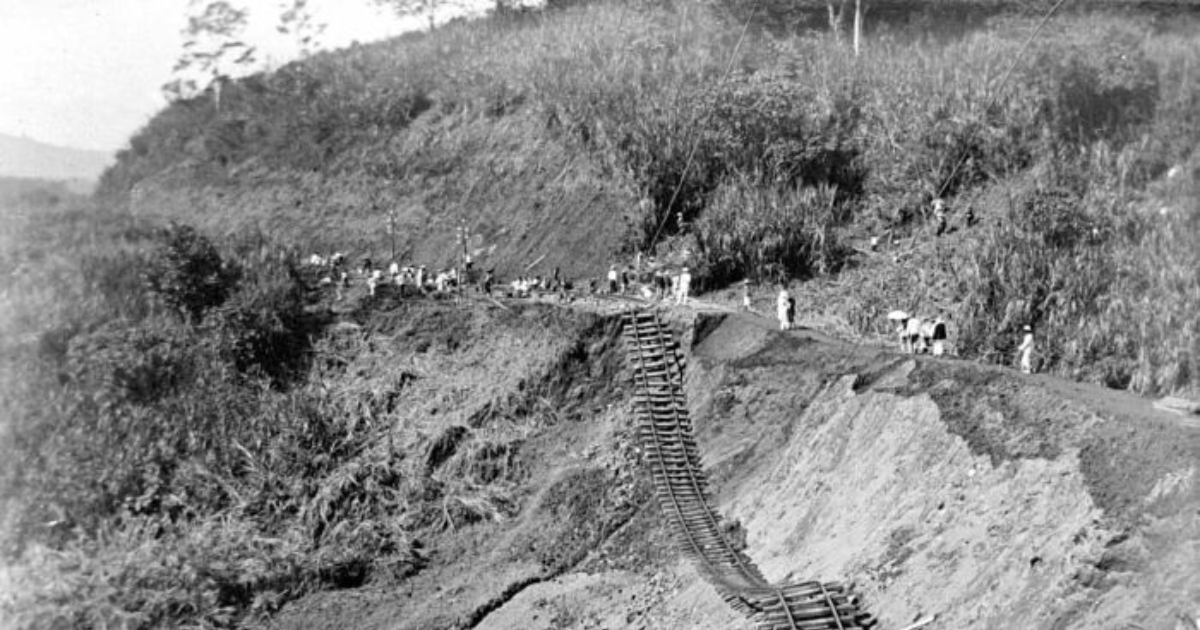
The earthquake that struck Cipatat in early January 1911 caused severe damage in various locations. The tremors lasted from morning until midday and were believed to be a continuation of a series of seismic activities that had shaken the region since mid-December 1910[1].
Prior to the early-year earthquake, Cipatat had already been shaken by seismic activity since mid-December 1910. According to Natuurkundig Tijdschrift voor Nederlandsch-Indië, an earthquake in Cipatat was reported to have occurred on 18 December 1910 at 9:00 a.m. The tremor originated at coordinates 6.8° South Latitude and 107.4° East Longitude, precisely north of the Tagogapu–Cipatat railway line.
Although relatively minor, the earthquake caused damage to several buildings. Cracks appeared in a number of structures, including the guesthouse, the Cipatat station building, the signal house, the coal warehouse, and the locomotive depot. Nevertheless, the December earthquake did not disrupt railway traffic[2].
In contrast to the earlier tremor, the earthquake that occurred in early January caused extensive destruction. Houses were damaged, telephone poles collapsed, and roads cracked. The quake also triggered landslides between Cipatat and Tagogapu, paralyzing the railway system. As a result, a train from Bogor was canceled and sent back to its station of origin[3]. Meanwhile, passengers were redirected to Padalarang using horse-drawn carriages.
Citing Preangerbode, the newspaper Bataviaasch Nieuwsblad reported that Cipatat Station suffered considerable damage. The walls inside the station rooms were visibly cracked, and daylight could be seen from within. The station’s water tower was also damaged. As a consequence, the staff moved equipment and goods outside the building. To avoid the risk of aftershocks, station services were temporarily conducted outdoors[4].
At Cipatat Station, several officials and experts from the colonial railway company, Staatsspoorwegen (SS), gathered to discuss the situation. They sought the best solution to restore railway operations. The railway tracks between Cipatat Station and Tagogapu were effectively unusable due to landslides[5].
Subsequent inspections revealed numerous cracks along the ridge traversed by the railway line. The most severe damage occurred on sections forming embankments, where soil subsidence caused the tracks to hang suspended. Near Tagogapu, a major landslide also destroyed an embankment approximately 200 meters in length.
Following the earthquake, these landslides nearly endangered a train traveling from Bandung. The train, which departed from Padalarang Station at 06:04, reached the hazardous section at the same time as the strongest tremor.
The train driver was unaware of the collapsed track ahead, as visibility was limited by the curved railway line winding through the hills. The train was ultimately saved when a local youth issued an emergency warning by waving a red flag fashioned from his trousers. Seeing the danger signal, the driver immediately applied the brakes and brought the train to a halt just in time[6].
References:
[1] Aardbeving. Bataviaasch Nieuwsblad. Edisi 4 Januari 1911.
[2] Natuurkundig tijdschrift voor Nederlandsch-Indië. 1912. Deel: LXXI, 01-01-1912. Batavia: Lange en Co. Halaman 162-163
[3] Aardbeving. Deli Courant. Edisi 5 Januari 1911.
[4] Aardbevingsmisere. Bataviaasch Nieuwsblad. Edisi 6 Januari 1911
[5] Aardbevings-misère. Het nieuws van den dag voor Nederlandsch-Indië. Edisi 05 Januari 1911
[6] Aardbevings-misère. Het nieuws van den dag voor Nederlandsch-Indië. Edisi 05 Januari 1911

Leave a Reply